Deyaneria on April 13th, 2011

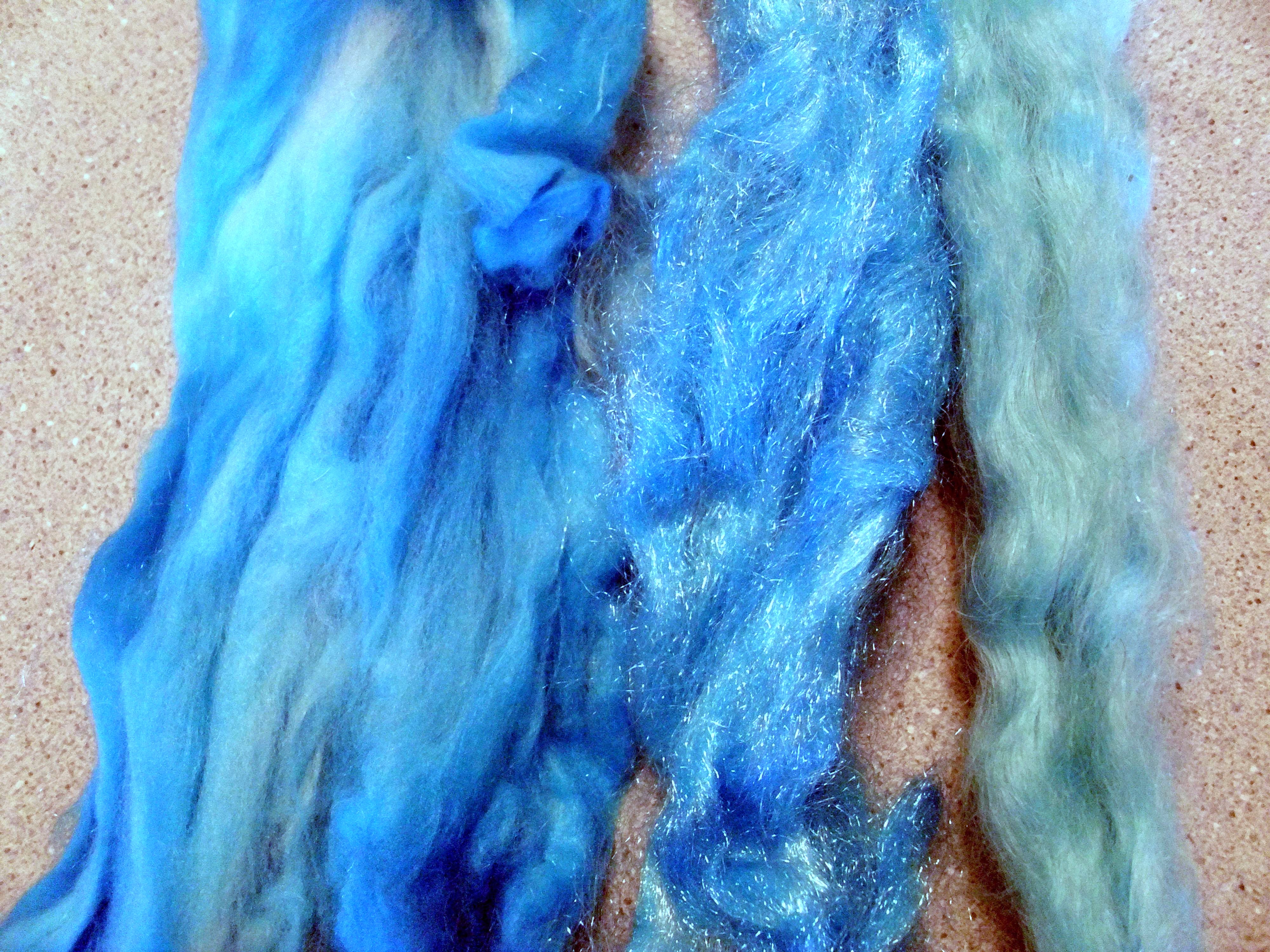
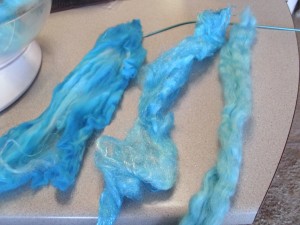
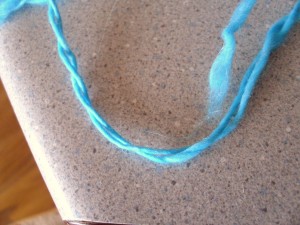
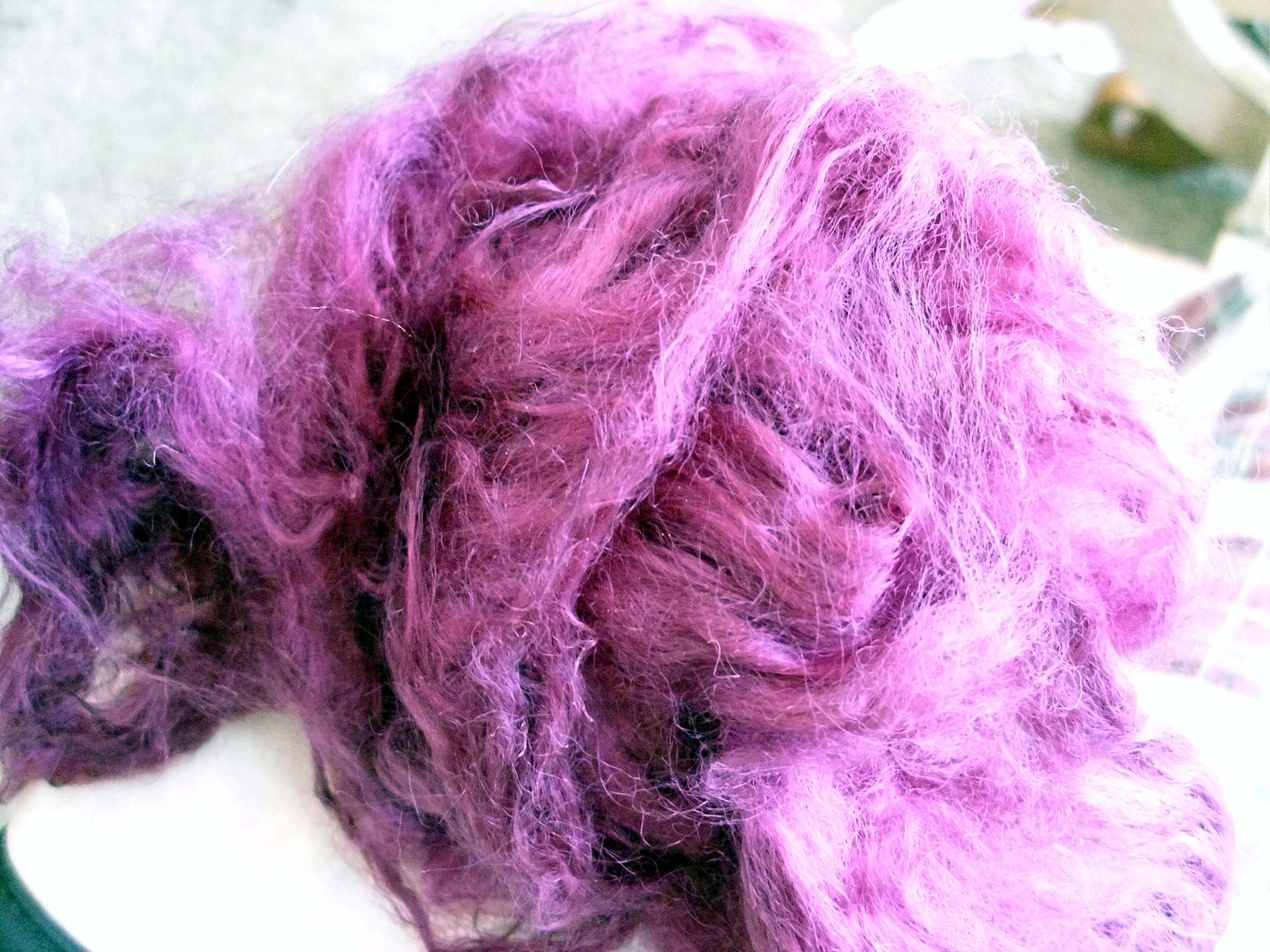
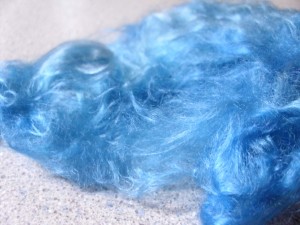
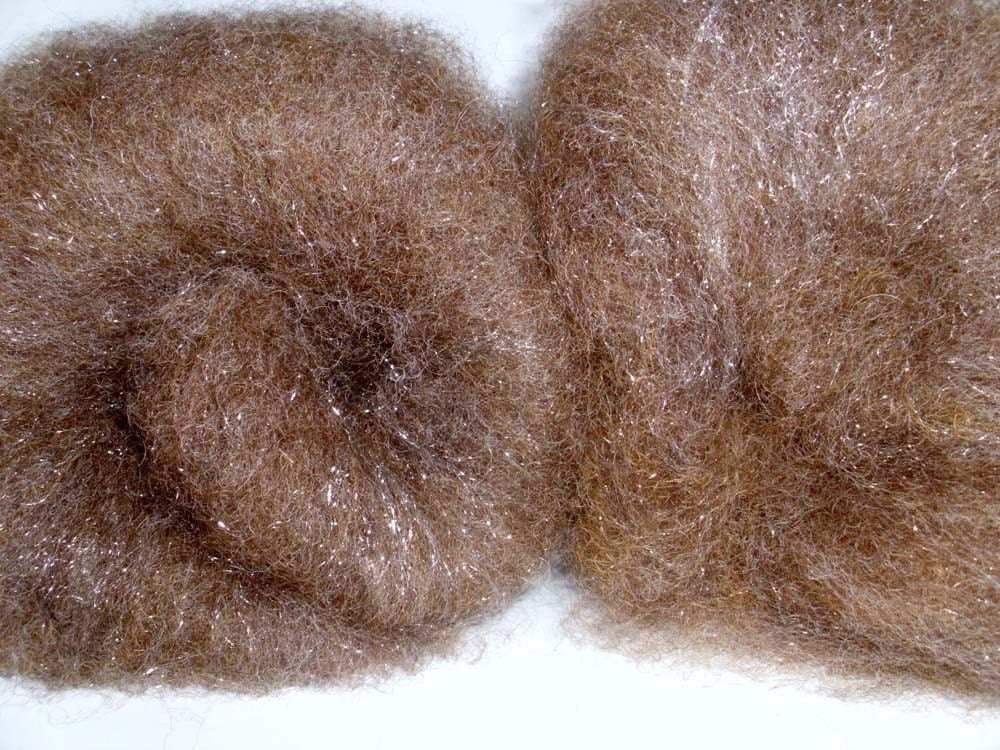
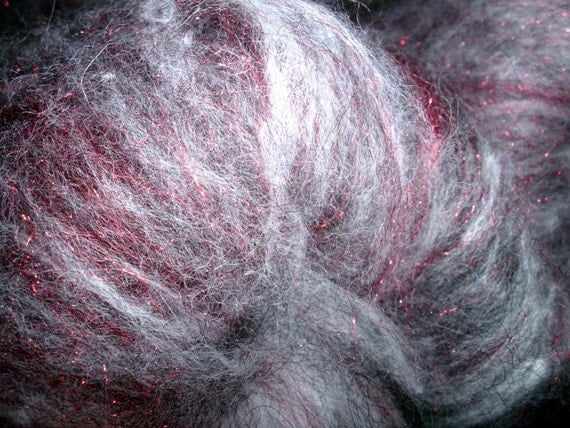
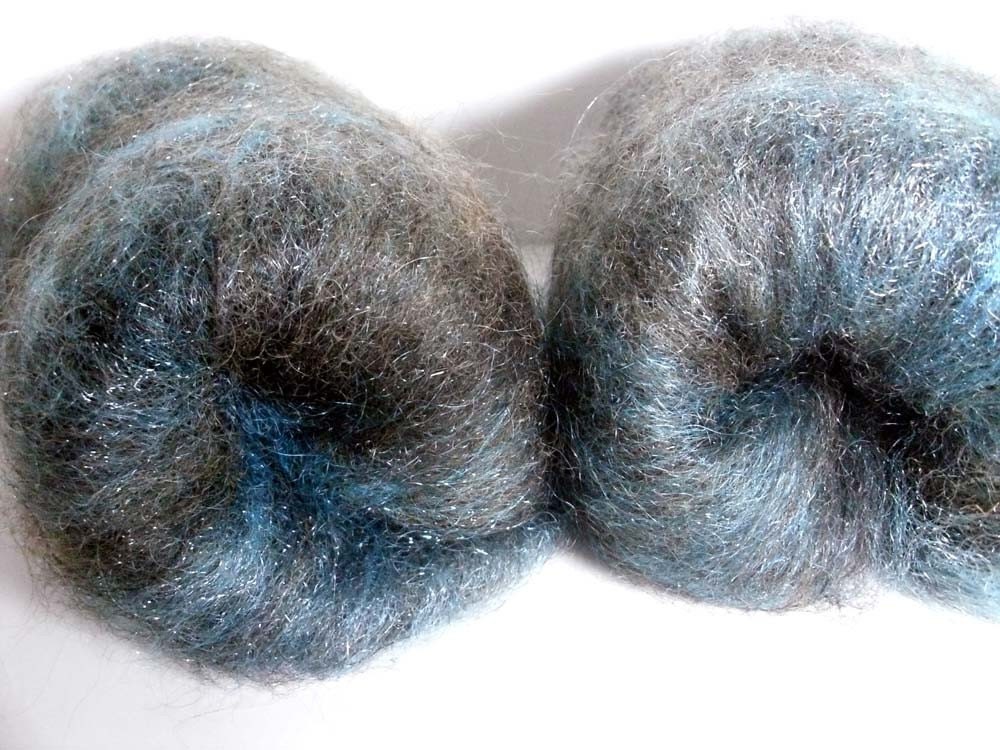
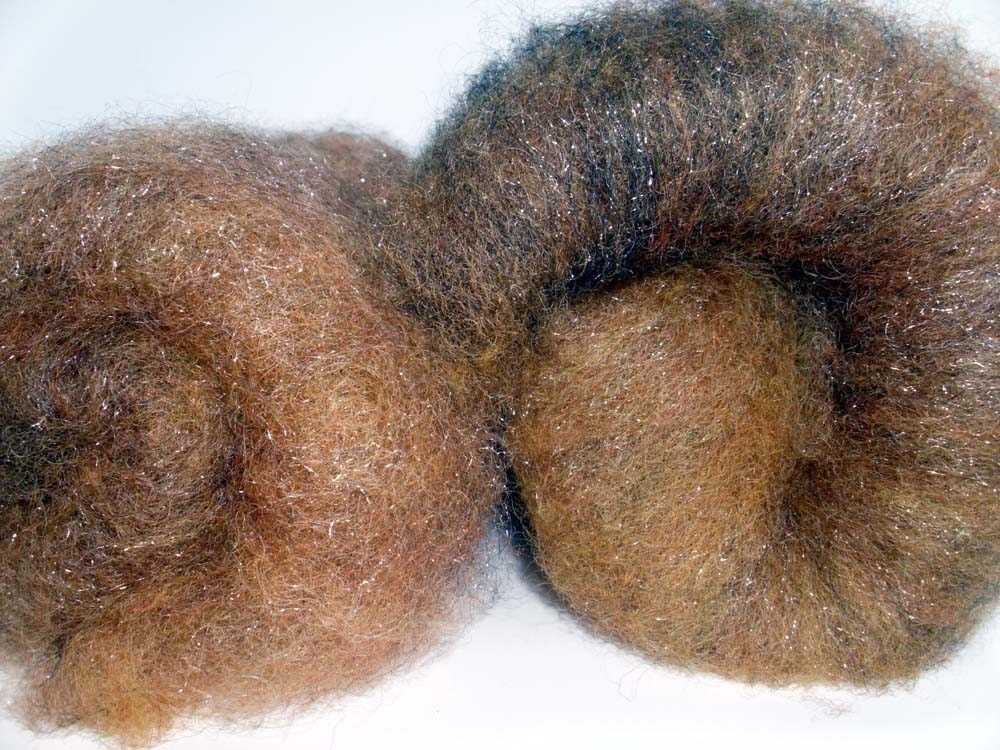
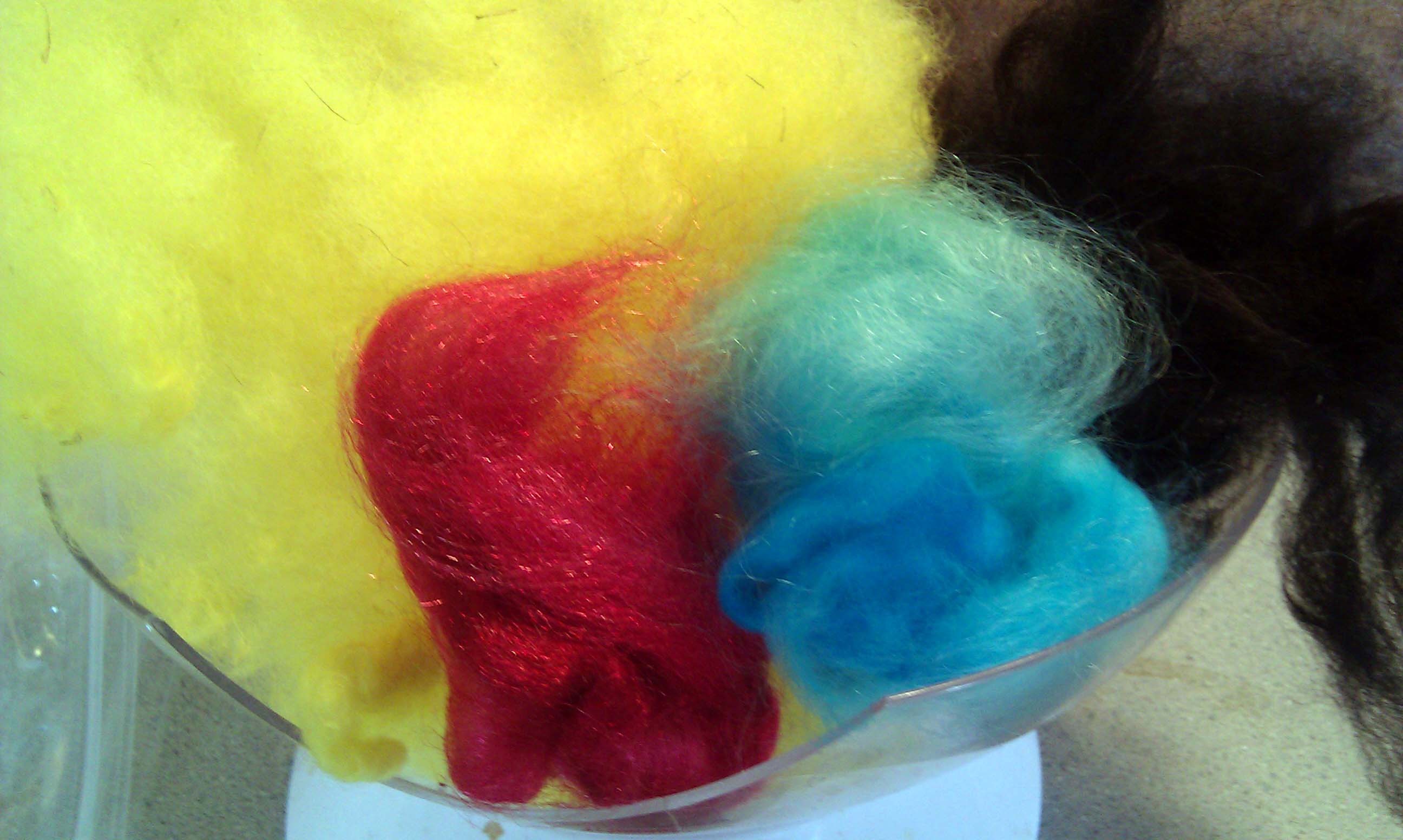
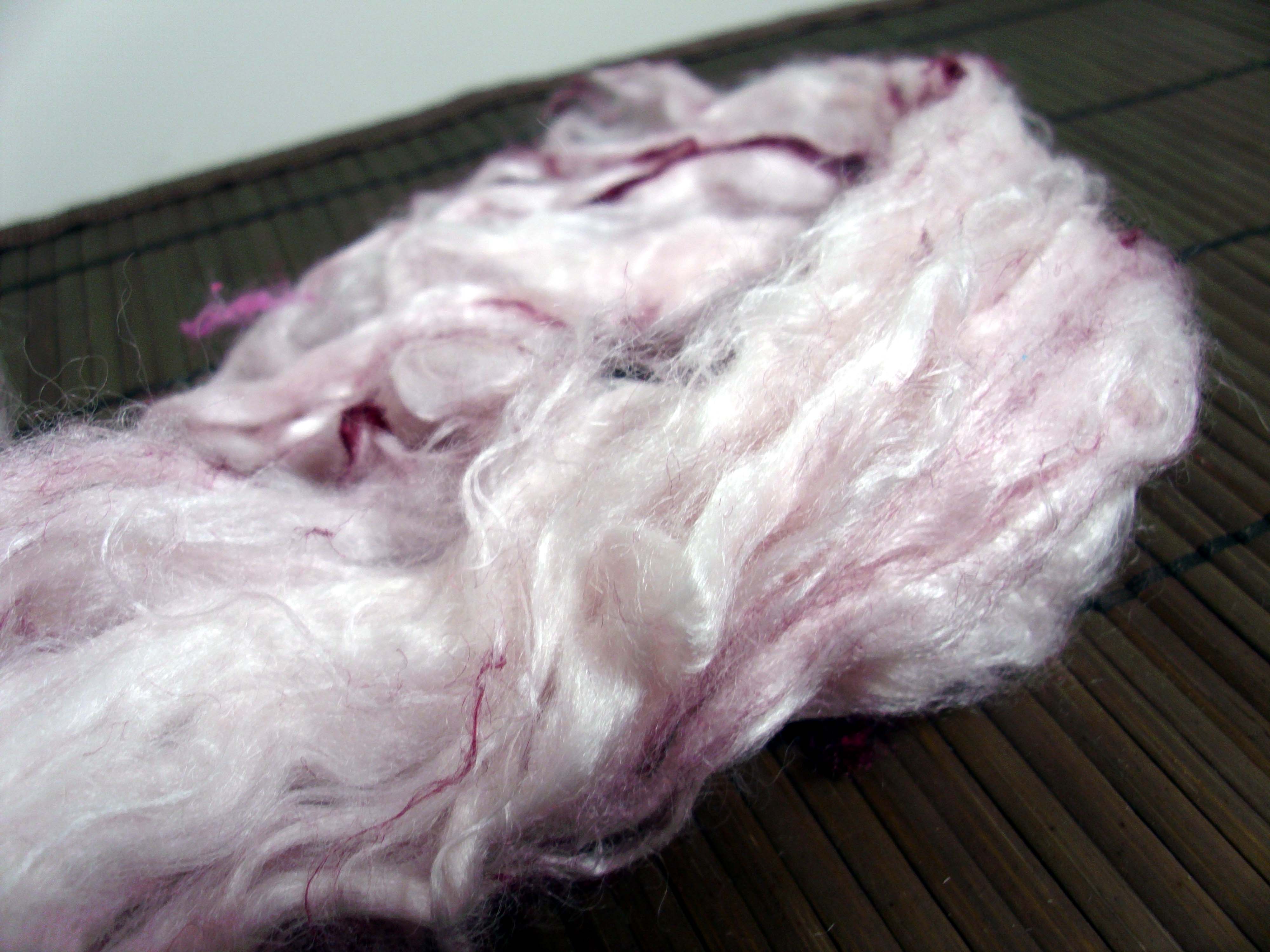
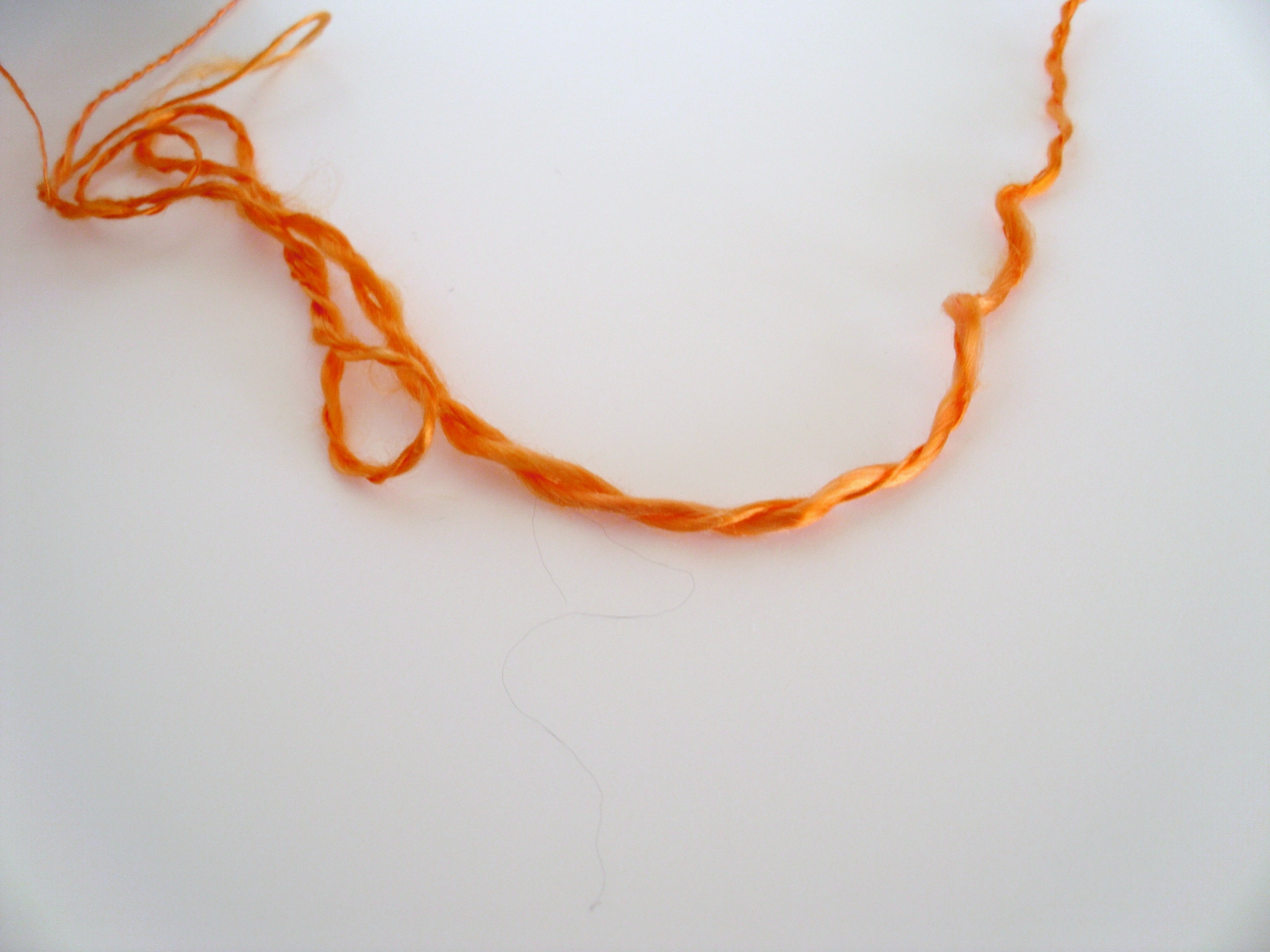
Nylon dyes really well with acid dyes I used cushing’s acid dyes in peacock. I dyed a bit of mohair, blending nylon and firestar. To show differences, in how they pick up colors.

Blending nylon, firestar, mohair all done in the same dyebath.


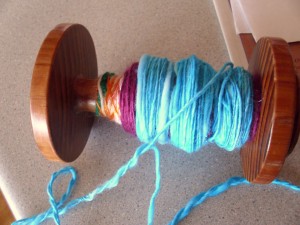
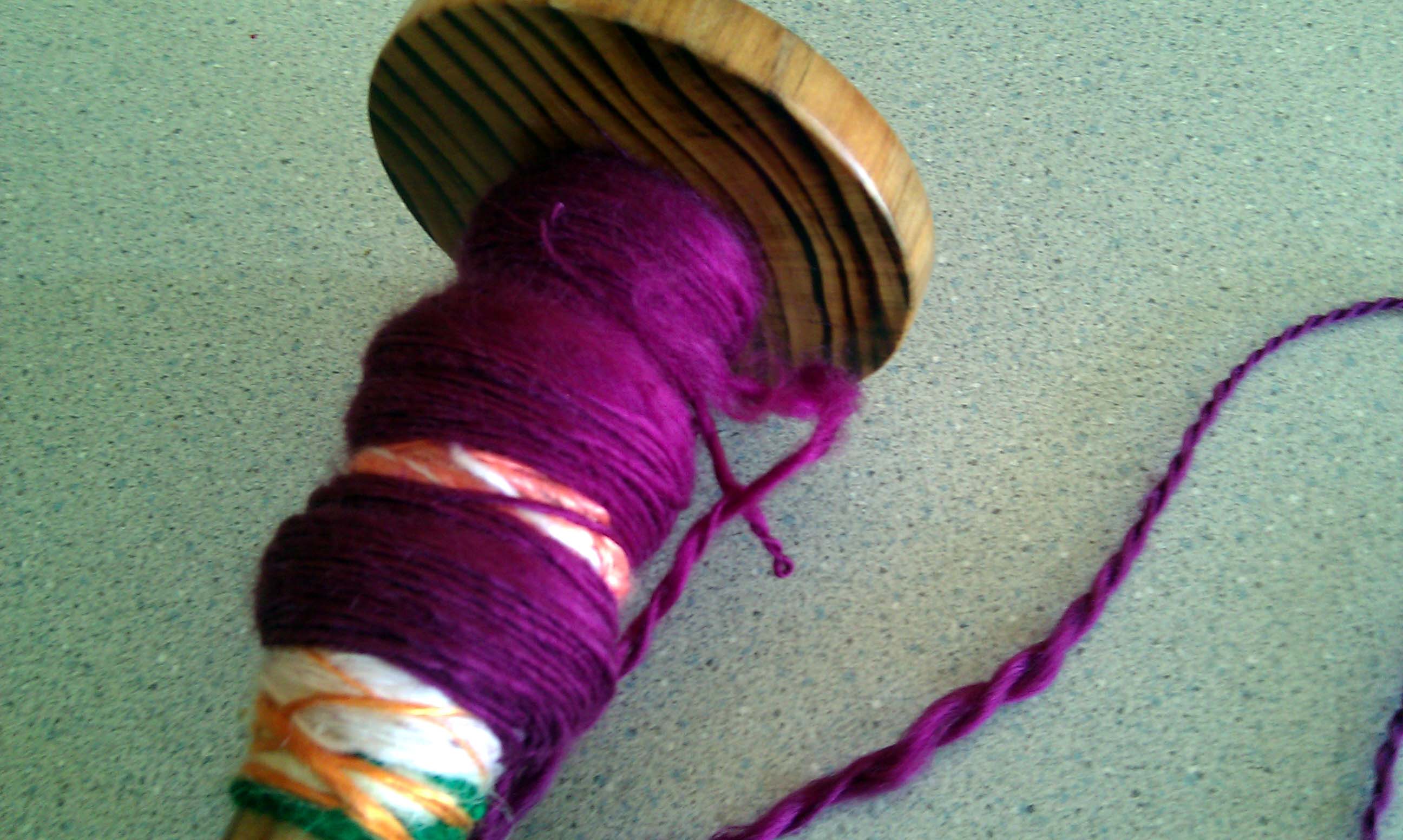
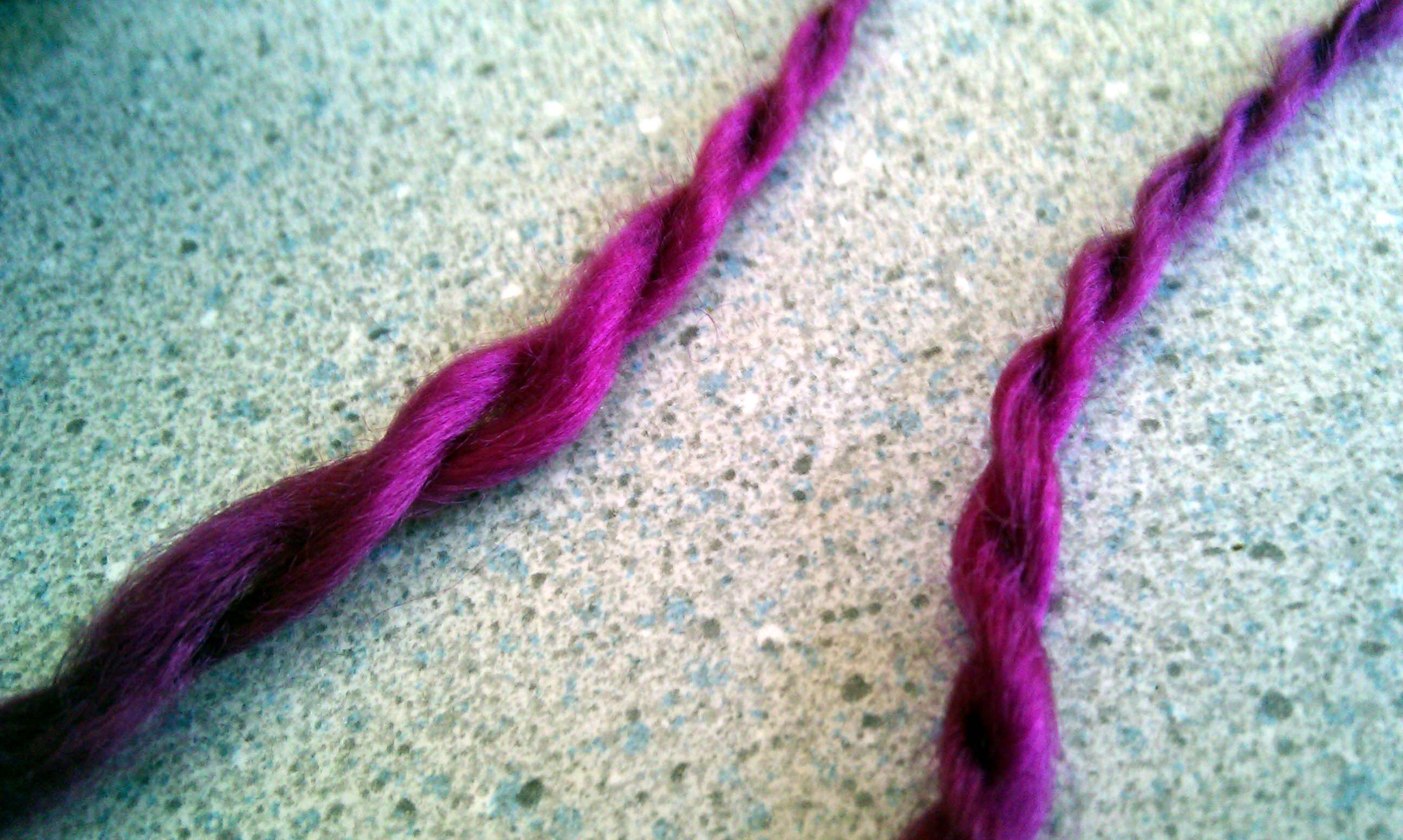
All Spun Up it’s striking against last weeks plum colored fiber on the bobbin.

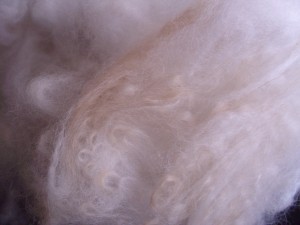
Another sneak peek into the store.  Mixed angora combings I have a bunch.

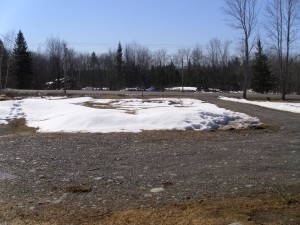
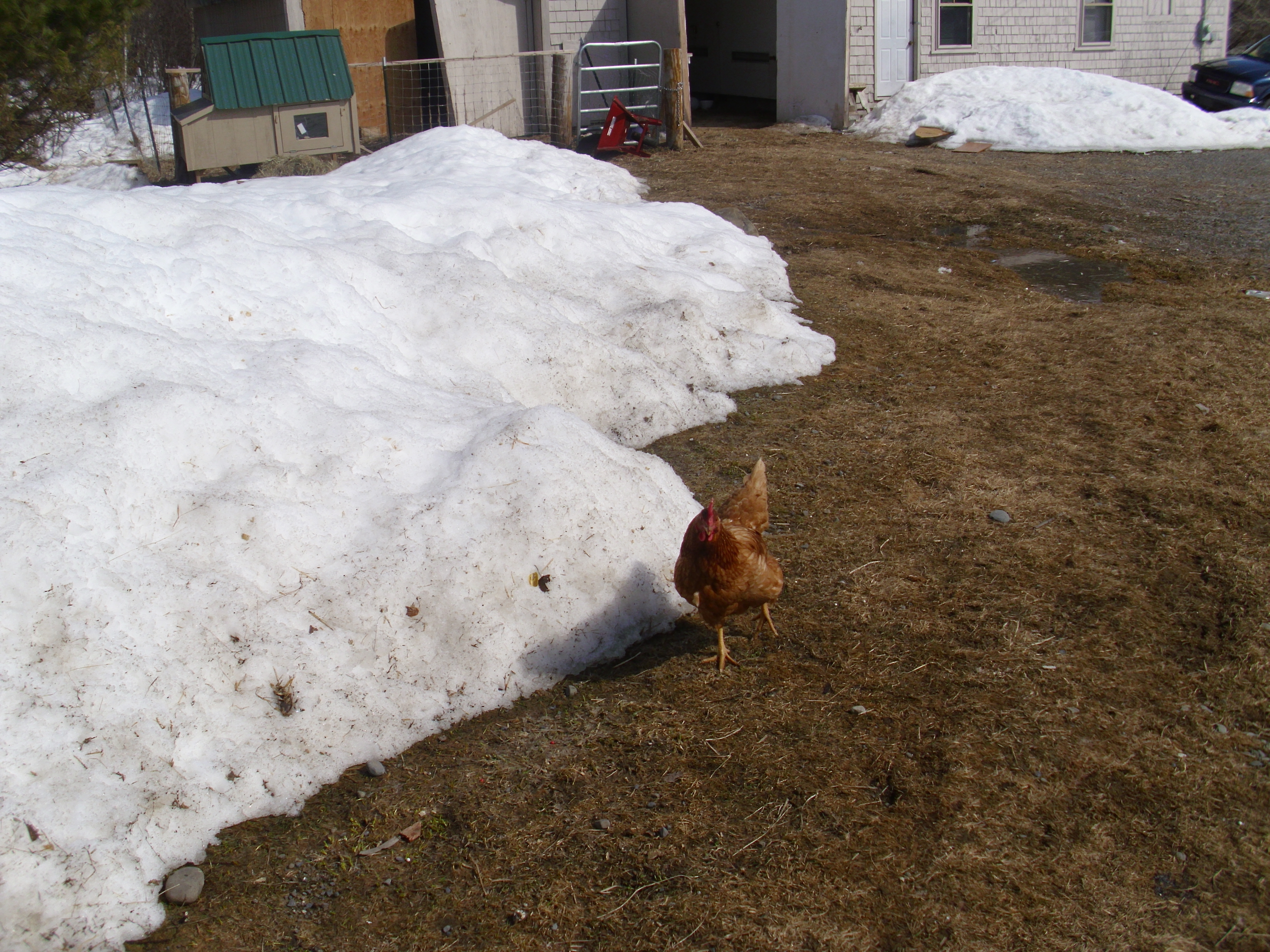
We still have some big old snowdrifts around here.

I have a basket full of fiber left from combing top. I’ll do a random drawing for everyone who likes “the fiber of my being” facebook page and comments below.  Contest ends April 14 midnight the winner will be drawn by random number generator and posted in Friday’s  blog post.

Disclaimer: Fiber is seconds from 8in long coopworth combings..while not 8 inches it will have a pretty good staple. There may a bit of veggie matter in this. There may also be a few neps. I would normally card this fiber into batts as there is really nothing wrong with it.

P.S. The fiber weights 3 3/8 oz.

Tags: , , , , , , , , , , , , , , , , , , , ,

Deyaneria on April 11th, 2011

Nylon is an interesting fiber completely man-made. Nylon was in vented in 1935 by Wallace Carothers who worked for Du-Pont. It hit the markets in 1939 and was an instant hit, especially as a replacement for silk in hosiery. Carothers never got to see the impact that his invention made on society. He died in April, 1937.

Nylon is a synthetic fabric made from petroleum products( so it’s not very Eco-friendly). It was developed as an alternative to silk, although it quickly became unavailable to civilian consumers, because nylon was used extensively during the war. Nylon is valued for its light weight, incredible tensile strength, durability, and resistance to damage( great for socks of course). It also takes dye easily, making nylon fabrics available in a wide array of colors for consumers.

Today, nylon is among the many polymer products in common daily use throughout the world. It is the second most used fiber in the United States, since it is so versatile and relatively easy to make. Like most petroleum products, it has a very slow decay rate, which unfortunately results in the accumulation of exhausted nylon products in landfills around the world (hmmm wondering if we should be using this product).

Nylon is produced by a melt spinning method. Basically the nylon is melted and run into a spinneret and then cooled to solidify it. By using different shaped spinnerets octagonal,pentagonal, trilobal etc, it create different effects  such as a matt look or a glittery look some shapes hide dirt well (hence why nylon is used for carpeting). Here is an entire diagram of how it is made starting with crude oil.

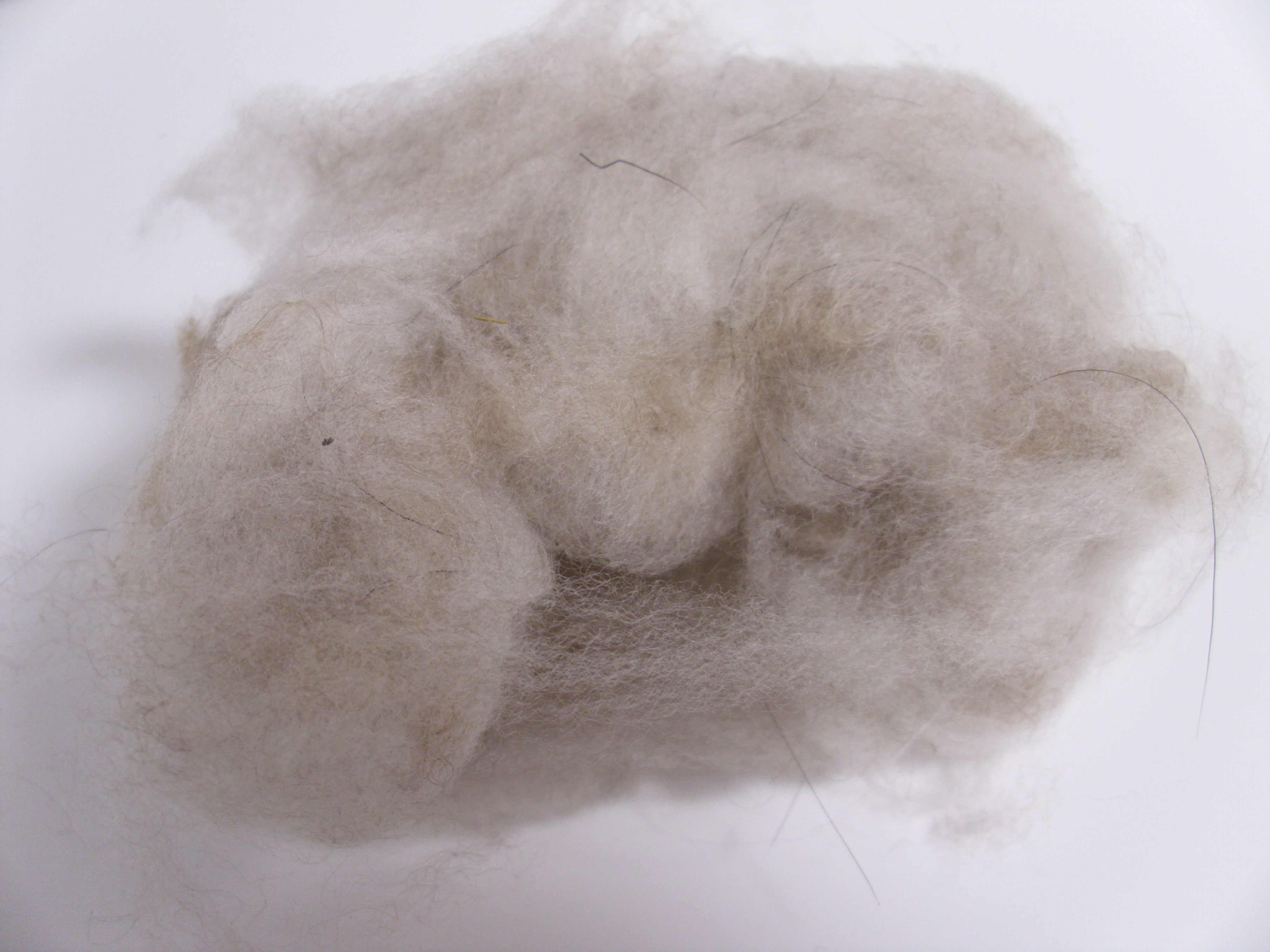
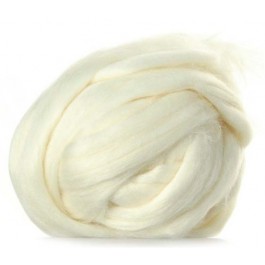
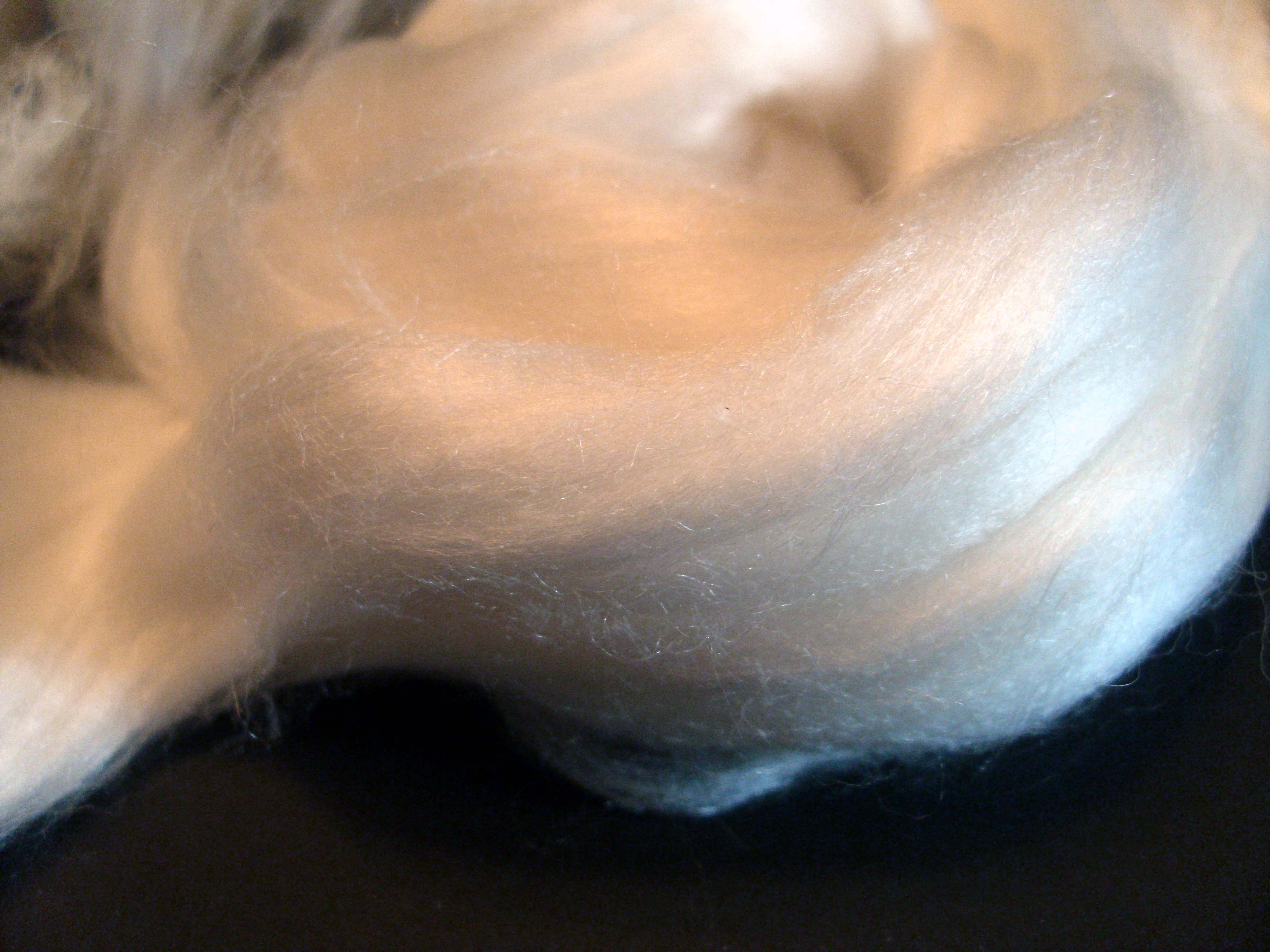
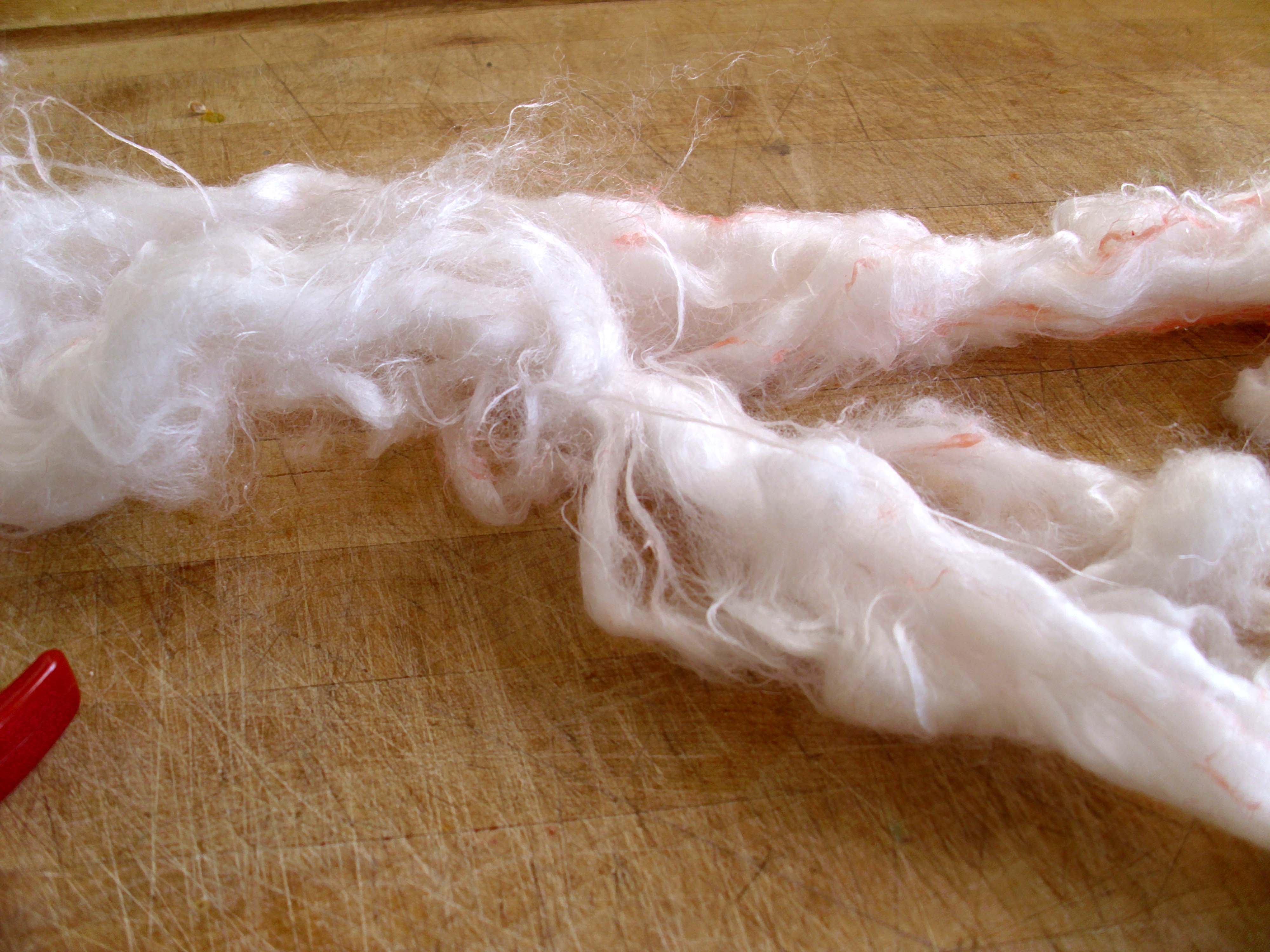
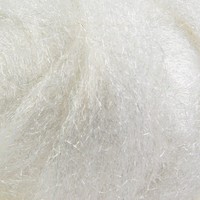
I found 3 separate types of nylon spinning fiber(there may be more). The ones I found are blending nylon, what you would use in socks, Icicle made by Louet it has some shine , and firestar which is the most shiny of all. All the fiber is dyeable with acid dyes.
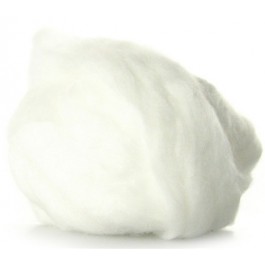
 

white nylon for socks


icicle


firestar


Top blending nylon, middle icicle fiber, bottom firestar(hard to capture shine on this one, actually the shiniest)
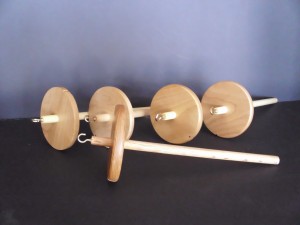
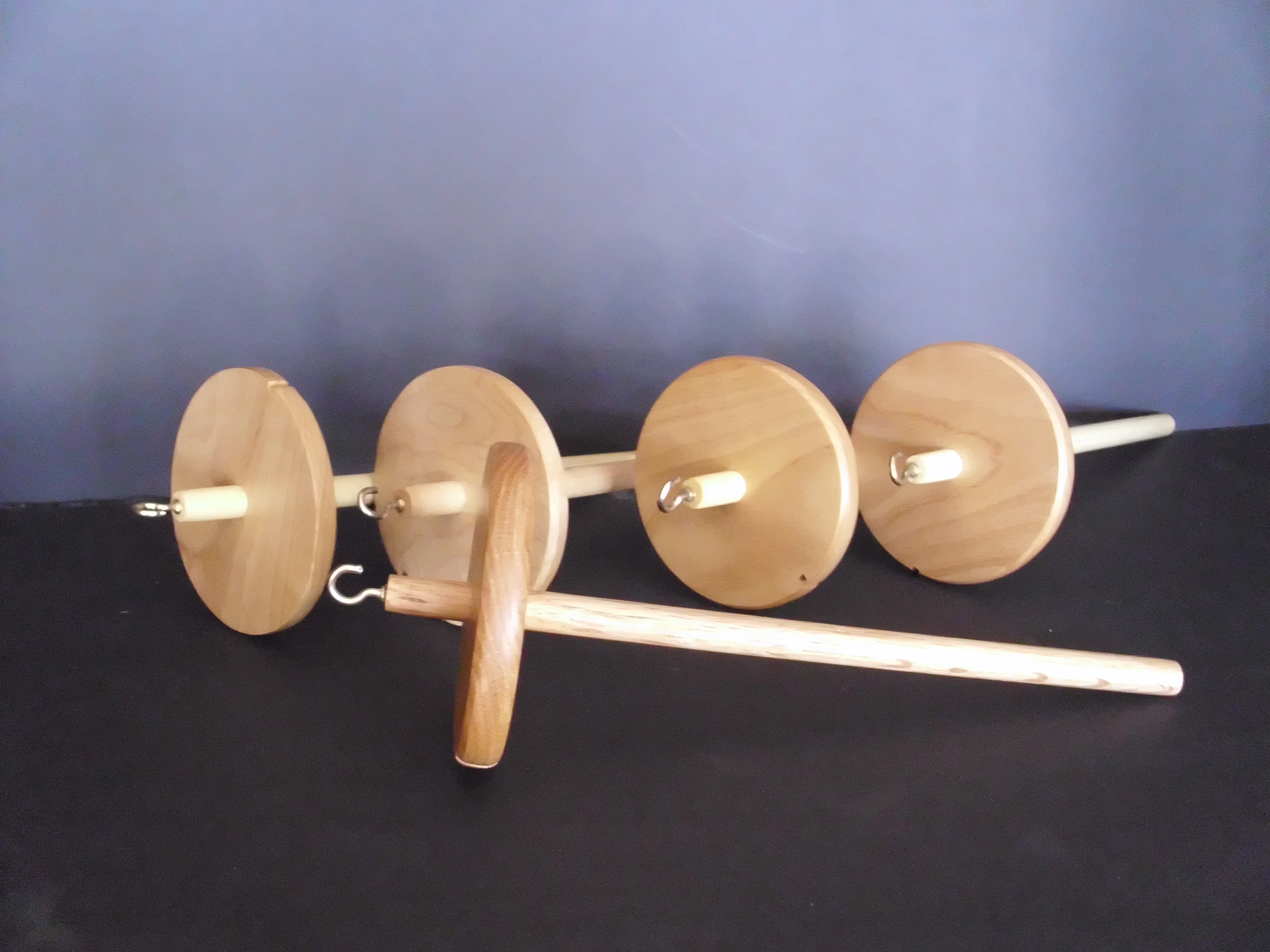
In store news we have new spindles being added to the store this week.
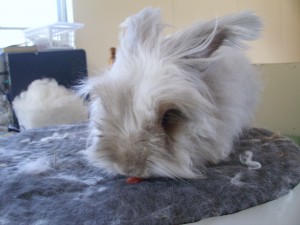
This is Teddy. He had a pluck this week. In the background you can see his tote of fiber.

I have a basket full of fiber left from combing top. I’ll do a random drawing for everyone who likes “the fiber of my being” facebook page and comments below.  Contest ends April 14 midnight the winner will be drawn by random number generator and posted in Friday’s  blog post.
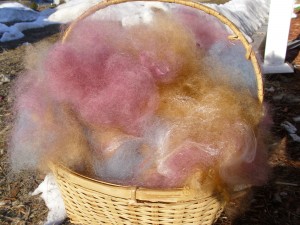
Disclaimer: Fiber is seconds from 8in long coopworth combings..while not 8 inches it will have a pretty good staple. There may a bit of veggie matter in this. There may also be a few neps. I would normally card this fiber into batts as there is really nothing wrong with it.

P.S. The fiber weights 3 3/8 oz.

P.P.S. The new video for the “From Llama to Shawl/Scarf” has been postponed until next week. I have a few personal things to take care of. Thanks for your understanding.

Tags: , , , , , , , , , , , , , , , , ,

Deyaneria on April 8th, 2011

This week on the farm has been uneventful. After the last week and half of being teased about spring and then being dumped on by snow, I no longer care if it snows. You hear that Murphy!!!!! I don’t care!!!!! However, the sunshine has been nice to see and the animals are loving it.

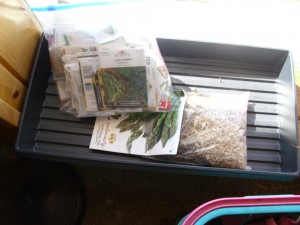
I’m thinking that just after Memorial Day, I will be planting the garden I need to get my starters going.

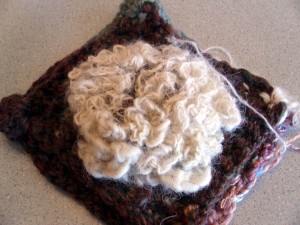
I haven’t worked on my son’s socks but here is a pic of one of my squares for The Carnation Bouquet Afghan Project. Drew Emborsky(A.K.A. The Crochet Guy) wanted to put together some afghans  for charity. If you want to learn more you can check out his Blog. I’ve also been working on a couple secret projects.

The hubs will be making a visit next Wednesday for about a week. It will be nice to have him home for a bit.

Here are a few new things in the Store. From Left to right Old World Swallowtail, on the left Spindle kit with 2 oz of top.

I’m thinking about another contest. I have a basket full of fiber left from combing top. I’ll do a random drawing for everyone who likes “the fiber of my being” facebook page and comments below.

Disclaimer: Fiber is seconds from 8in long coopworth combings..while not 8 inches it will have a pretty good staple. There may a bit of veggie matter in this. There may also be a few neps. I would normally card this fiber into batts as there is really nothing wrong with it.

P.S. The fiber weights 3 3/8 oz.

Tags: , , , , , , , , , , , , , , , , , , , , ,

Deyaneria on April 6th, 2011

Well now that we know how milk fiber is process and what it is made up of, I was extremely curious on how it dyes and spins. I used Cushings direct dye in plum and it turned out awesome. Did not run or exhaust the dye bath.

I also tried Cushings acid dye in peacock. Also turned out great. Exhausted the dye bath did not run. I notice colors are more matt with this fiber as opposed being shiny like corn or nylon.

Spinning was interesting. The fiber feels fine and dense like angora but isn’t slippery it has alot of grab(sometimes a little too much grab for my liking). It’s definitely next to skin soft but the grabbiness (is that even a word) made it seem a little less soft than angora. It definiteley reminded me of a very, very fine merino.

 Sorry about the picure quality, My camera is a Diva and only working when it wants to so I had to use my cell phone. Don’t tell the old camera but the replacement is already on it’s way.


Here is Fluffy wanting my attention. She gets right up in your face and can be a bit demanding. She was literally in my lap at my desk climbing up me in this picture.

Oh and here is some lovely Cashmere from the goats…..Loooove me some cashmere. I still have one goat to comb out for the year and I’ll decide if I send it out to be processed or process it myself. The amount of guardhair looks minimal so I may just process it at home(maybe).  I need to go pet some now.

P.S. Remember Sign up for the newsletter to get access to “The Llama to Shawl/Scarf Series” next installment comes out April 12th.

Tags: , , , , , , , , , , , , , , ,

Deyaneria on April 4th, 2011

I tried out some milk protein fiber recently. I had to wonder after my experience with corn fiber how much of it was actually still milk and how much manufacturing it went thru.

milk protein fiber

Here is a bit of history:” Milk fiber was invented in 1930’s in Italy and America to compete wool. The fiber known as ARALAC, Lanatil, Merinova all different brands for the same fiber manufactured from milk casein fell victim to their minor flaws and the war. “( from Euroflax website)
Now for the scientific part: It seems that at it’s humble beginnings they use the skim milk that is left from butter making. Casein, the principal protein of milk, is essentially the same as cottage cheese. It is a relatively pure protein and is available commercially in large amounts. So does this mean we could manufacture this fiber?
Casein for making fibers must have a high degree of purity.  The preparation of a suitable spinning solution is the first stage in the production. The casein is dissolved in water that contains about 2 percent by weight of alkali to make a viscous solution with 20 to 25 percent protein. The next step is to pump the filtered casein solution by a metering pump through a platinum-gold alloy disc, or spinneret. The solution, streaming from the holes of the spinneret, is immersed in water that contains an acid. The acid neutralizes the alkali used to dissolve the casein. The small, continuous fibers are then stretched, treated in various solutions, and collected by the spinning machinery.
 OK this is definitely not something I could not do at home. I am now wondering an alkali and an acid , how green is this “green” fiber? I couldn’t find much on what  alkali they are using it could be baking soda for all I know.  I second part the acid and strengthener so to speak used to be formaldehyde and aluminum salts. EWww not something I would want to spin. However manufacturing techniques have changed a little bit since the 1930’s and now this fiber has the  Oeko-Tex Standard 100 green certification. So what changed?
 

One thing that changed is they took out the formaldehyde and and added acrylonitrile (AN). I first thought I’m not sure one is better than the other. But then I took another look at AN. “Acrylonitrile is the key ingredient in the acrylic fiber used to make clothing and carpeting…telephone and computer casings and sports equipment; and in nitrile rubber, which is used in the manufacture of hoses for pumping fuel. Acrylonitrile is used to produce plastics that are impermeable to gases and are ideal for shatterproof bottles that hold chemicals and cosmetics, clear “blister packs” that keep meats fresh and medical supplies sterile, and packaging for many other products. It is also a component in plastic resins, paints, adhesives, and coatings” (The American Chemistry Society). So we touch AN everyday so it must be fairly safe. Basically today’s Milk fiber is a combination of Milk Protein and Acrylonitrile, because it is a regenerated protein fiber it acts more like wool than plant fibers. This means that hopefully it should dye like wool.


In other news the winner of  the Guess the Butterfly Contest is Tal HadaniPease. You had the first correct response of Old World Swallowtail. Congratulations!!!! I’vc sent you an email to get the mailing specifics and your colorway of choice. Here are all the coloways in the shop right now. From left to right top to bottom they are : Silver-spotted skipper, white-rayed pixie, gilbert’s flasher, monarch, pipevine swallowtail, rocky mountain parnassium.

Tags: , , , , , , , , , , , , , , ,

Deyaneria on April 1st, 2011

I’ve been slowly collecting cashmere off the goats. Just in time too as I’m down to 1 pd of stock cashmere left. The goats are all looking alot skinnier except for Gabby. Her fiber just isn’t ready to release yet.

Gabby

The chickens have majorly started laying again. We collected 8 eggs in one day and we only have 5 hens. There was a giganto egg about 100 grams( a normal large store bought egg goes about 60 grams). My normal eggs go about 65 grams. This egg was huge and unthinking me I ate it for snack  before I snapped a picture. I just had to see how many yolks it was(it was a 2 yolker). Oh well maybe next time.

I’ve been waking up an hour earlier to get more done with the store here is what I was able to accomplish this week.


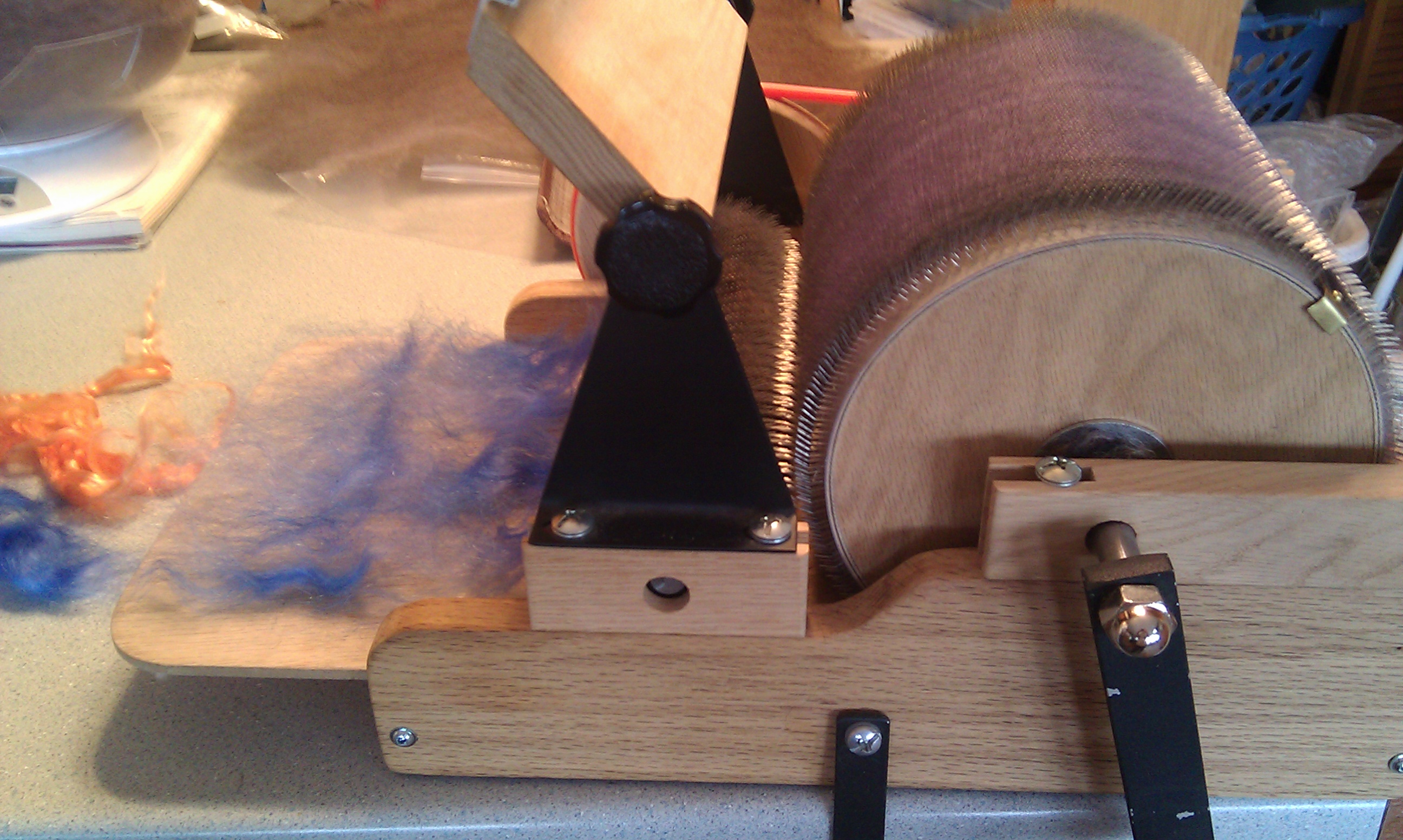
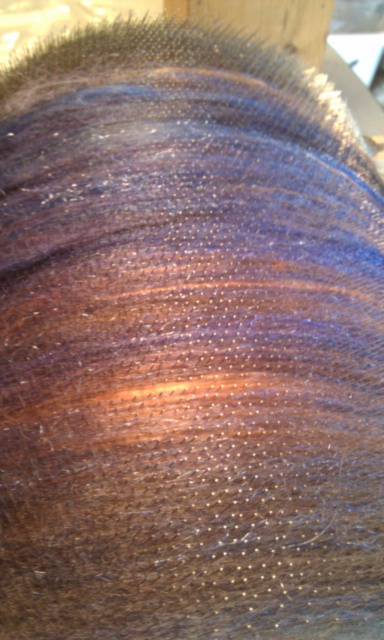
Drum carding


Butterfly Collection- Rocky Mountain Parnassium

Dyepot colorway – Moody

Butterfly Collection- Pipevine Swallowtail


I’ve decided to run a contest. I’m going to show you a picture of the fiber in next weeks Butterfly Collection. Guess which north american butterfly it is and you will recieve 2 oz of any butterfly collection fiber of your choosing for free. Put your guess into the comments on this blog and I will check to see who got the first correct answer. The winner will be announced on Monday’s blog .

Mystery Butterfly Colorway

Tags: , , , , , , , , , , , , , , , , , ,

Deyaneria on March 30th, 2011

Lyocell takes direct dyes beautifully, however it does not exhaust the dye bath and about 10 percent of the color comes out in rinsing. I used Cushings direct dyes. I’ve heard that fiber reactive dyes work really well if you want darker colors and they are more wash-fast.
Here is what happened when  I dyed lyocell in orange direct dye from Cushings Dyes.


Here is how it spun up. It’s a bit slippery but not as slippery as angora, the shine is gorgeous rivaling silk. It feels a bit denser than silk though. Also I found when I washed lyocell yarn it shrunk a bit not much though. I found out after research that lyocell fabric will shrink once about 3% and after that won’t shrink again.

Tags: , , , , , ,

Deyaneria on March 28th, 2011

Tencel is an interesting fiber. Actually Tencel is one brand name of the fiber which is actually called Lyocell. I couldn’t find a discovery or creation date for this fiber but I did find out that Lyocell was was first manufactured in 1987 by Courtaulds Fibres UK.


Quick Note: I realized really quickly that some people mix up viscose and lyocell as they are both marketed as rayon. The processes to make these fibers do differ even though they both come from wood pulp. They do have slightly different properties as well.


 My Tencel Top bought from Purple Fleece.


OK so what is it made of(I asked myself)? It is bleached wood pulp.


Lyocell is created through a process called solvent spinning. The wood pulp is dissolved in N-methylmorpholine N-oxide, creating a solution called “dope,” which is then pushed through a spinneret to form the individual fibers. After the dope has been spun into lyocell fibers, the fibers are washed and the chemicals retrieved from the water are purified and recycled. (Kadolph, Sara, and Anna Langford. Textiles:Ninth Edition.Prentice Hall. 2002.) Since there is little waste product, this process is relatively eco-friendly. However, it uses a substantial amount of energy, and uses an organic solvent of petrochemical origin.


Products made from lyocell can be recycled, incinerated, or digested in sewage. The fiber will usually degrade completely in just eight days in waste treatment plants.


While production of lyocell fibers is generally eco-friendly and environmentally sustainable,  it doesn’t always accept dyes well, and it has a tendency to “pill”.  The chemicals used to overcome these issues can be quite harsh and are usually the same chemicals used in the conventional garment industry.


I have to say I’m a bit suprised lyocell isn’t as eco-friendly as I first thought. Still I guess using a small bit of petrochemical and harsh dyes etc.  is better than starting with a petrochemical product.


PS. My Poncho is coming along.


PPS. Next Tuesday the next installment of “From Llama to Scarf/Shawl” will be posted. Sign up for our newsletter to gain access.

Tags: , , , , , ,

Deyaneria on March 25th, 2011

I’ve come a decision about the direction I want to take this blog in.  I still want to inform people about different fibers. However I also want keep to the whole reason I started this blog which is to share my life and my rescued animals with you. To be honest I’m having trouble keeping up with putting new items into the store and preparing the fiber I write about in the blog. I also feel that something is missing because I’m not writing about the farm as much. So from now on Monday’s and Wednesday’s post will be about fiber and technique etc. Friday’s post will be about the my love of fiber and fiber animals.
I didn’t really have many pics to go with this so I’ll just put a few Farmy pics.

Lorenzo last summer Lorenzo the lover and his ladies.

Tags: , , , , , , , , , , ,

Deyaneria on March 23rd, 2011

Corn Fiber is an interesting fiber. I thought” OK, it’s a vegetable fiber. I have direct dyes it will dye beautifully. ” Well here is what happened when I tried.
Before 1st Dye attempt

After dyeing with direct dyes.
As you can see the fiber took no color at all there are a few silk pieces that clung to it as it was in the dyepot together and any color it looked like it had picked up washed right out when I rinsed it.

Oh I thought well maybe because it is partially man-made it will process with the acid dyes. So back into the the dyepot it went same colorway in acid dyes.

As you can see nothing there either except it grabbed on the tussah silk a bit more and the the tussah is what is colored in this one. I was at myt wits end. So I decided to google.  Turns out that corn fiber is so manufactored that it has to be dyed the same way acrylics and polyesters do with a dispersion dye. They do make dispersion dyes for the home dyer. Some dyes I’ve found are Pro Chemical and Dye or Aljo Dyes. Pro Chemical and Dyes offers a dye sampler. I think I will give it a try. I’ll post more on this in a few weeks but here is how it spun for me. The fiber itself had a plump, almost elastic type feel without any elasticity. I think it would drape quite well.

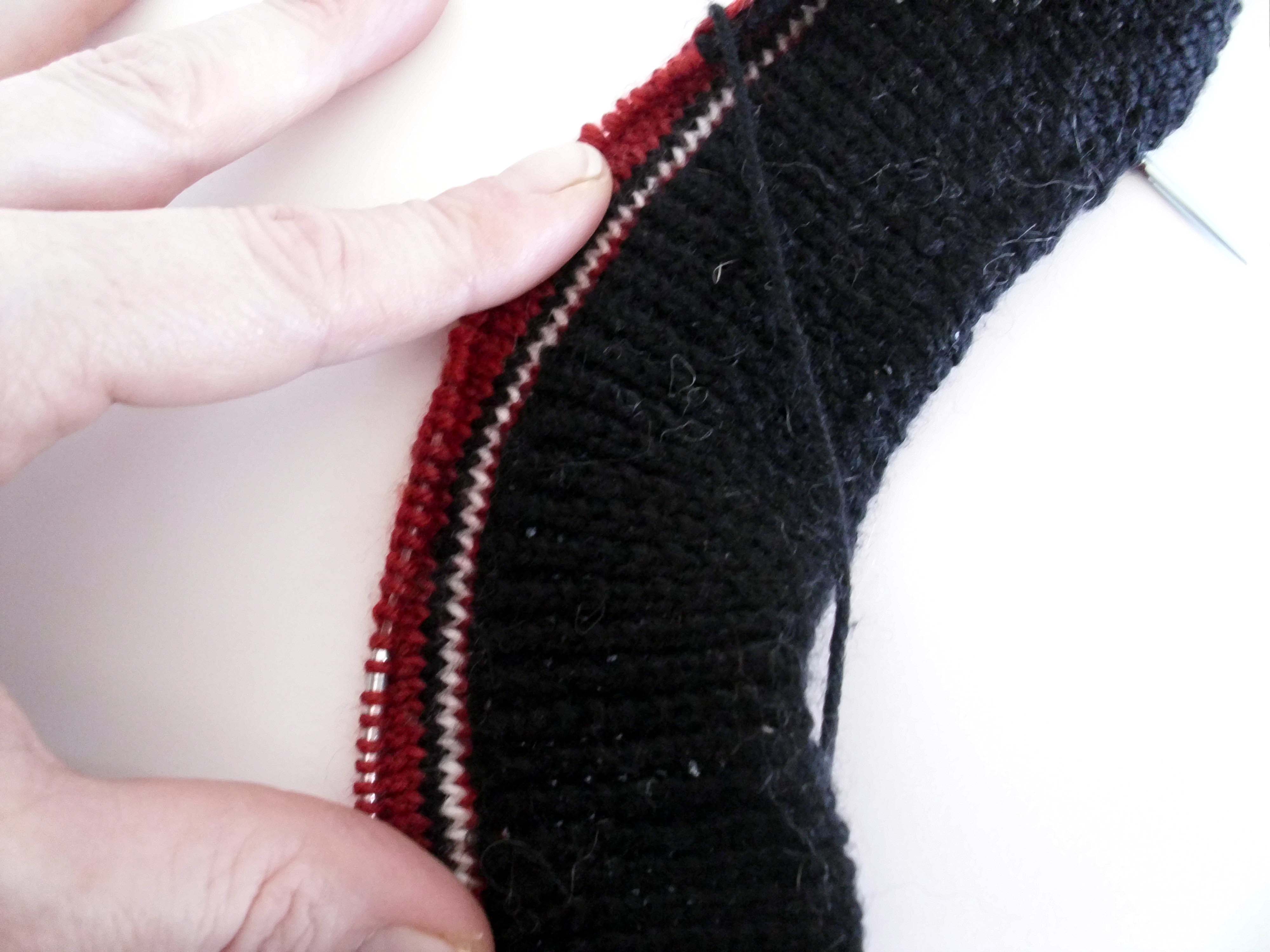
I finally started on my son’s socks he’s been begging me for the pattern is: Lucky Socks from Debbie Stoller’s book Son of Stitch and Bitch. I used Knit Picks Stroll in Firecracker Heather , Black, and Bare. Here’s what is started so far.

PS. Remember next week is another installment of the “From Llama to Shawl/Scarf Series.” Sign up for the newsletter to gain access to this instructive and entertaining video series.

Tags: , , , , , , , , , , , , , , ,